MID: The Threshold of Existence
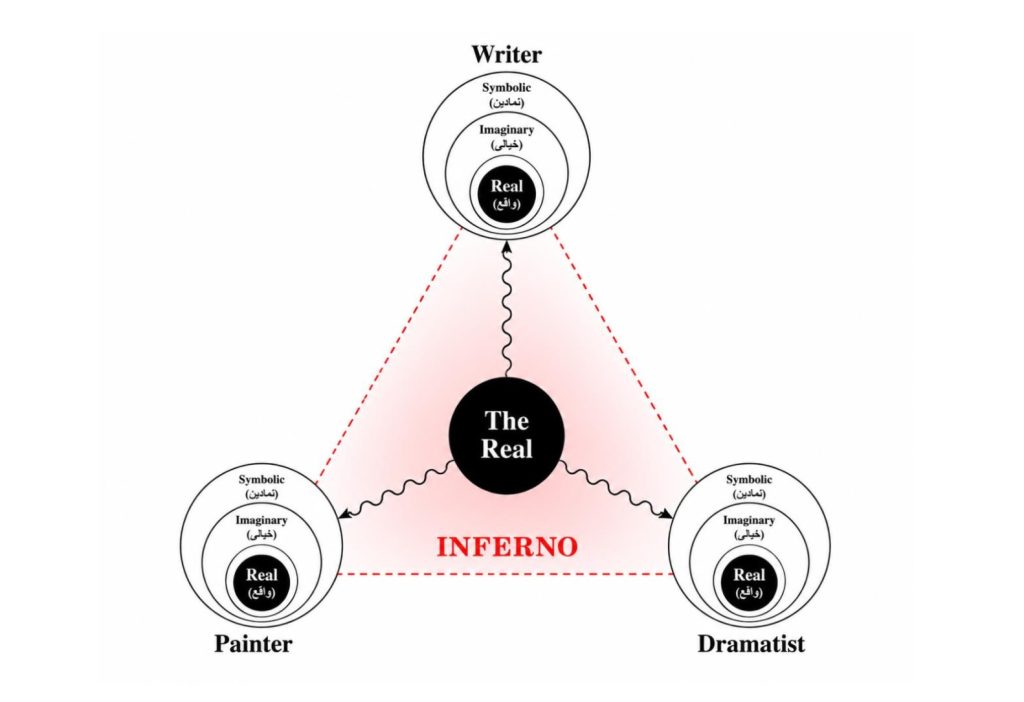
Dante begins his Inferno with these words: “Midway upon the journey of our life, I found myself within a forest dark.” This midway point becomes a point of departure toward a work staged centuries after Dante by another Italian artist: Romeo Castellucci’s Inferno, a contemporary one-and-a-half-hour performance featuring a massive stone building that encloses the entire background of the stage. With the presence of many actors, the work becomes a very different experience from a conventional adaptation. Castellucci constructs his post-dramatic hell through the presence of dogs, a horse, a piano that catches fire, and a net thrown over the audience’s heads, placing Dante’s text itself in a hellish condition. The hells of both works, despite their essential and topographical differences, remain intertwined through a tight knot. To analyze Castellucci’s method of organizing this adaptation, we turn to Lacan’s ideas. Our theoretical framework along this path is derived from Seminars 23 to 25 and the concepts elaborated in those texts.
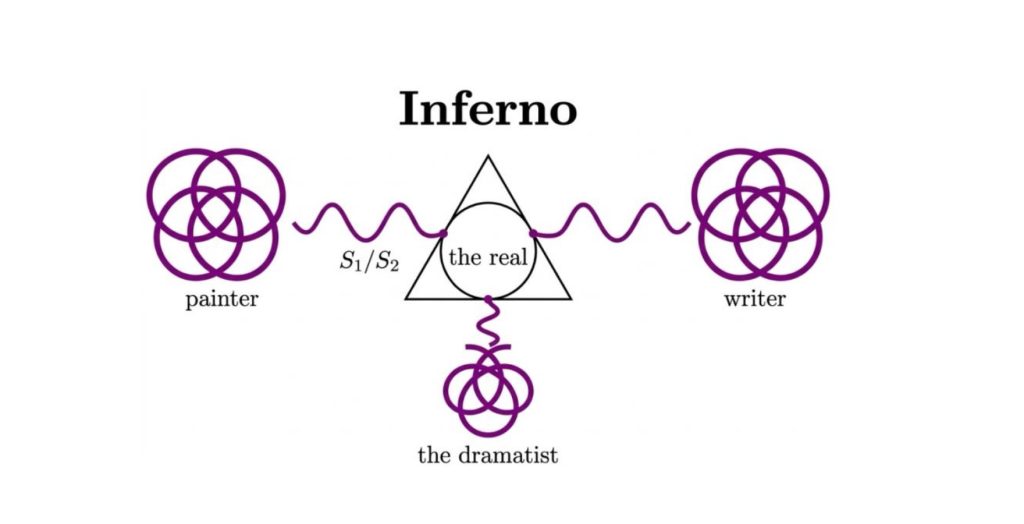
In his late seminars, Lacan emphasizes more than ever the human being as parlêtre, the speaking being. In this view, the boundaries of the human body as an entity are constantly exposed to the assault of a self-sufficient and complete language; a condition that confronts the human being with the failure of fully capturing reality. This condition causes truth to emerge always in a half-spoken, or mi-dit, form, leaving the devouring gap of language perpetually intact. At this point, Lacan summons another concept, one constructed from the combination of the words symptom and sin. This concept is the Sinthome: a tight knot that ties together our three existential registers, the Imaginary, the Symbolic, and the Real, and guarantees the continuity of the subject against the anxiety of encountering the indeterminate void of the Real. Art, and the creation of an inventive language for naming things, becomes a strategy for maintaining the balance of these three registers and redefining the Borromean knot in order to save the artist from the hell of collapse. In this sense, each artist creates a language of his own not simply in order to represent hell, but in order to approach a hell that cannot, in its totality, be spoken.
The signification of language in Lacan’s intellectual apparatus is defined at various levels. At the first level, we face the presumed mode of speaking, in which a signifier, S1, signifies a signified, S2. At the second level, the artist, by tearing the linear chain of connection between these two, disrupts the order of everyday discourse. Signifiers are released on stage without referring to a specific signified or meaning. None of the performative materials has a specific equivalent in the text. What does each of the things we see on stage refer to? Which circle of hell do these humans, whose presence is constantly repeated, belong to? Why are they in hell? No specific story is recounted. Or, on another level, a ball is not just a ball, as in the scene where an elderly woman at the front of the stage holds the ball in her teeth; and the firefighters have not come to save anyone, as in the scene where they dance with their bodies connected. This signifying rupture produces a surplus beyond everyday discourse, and this surplus is the artwork itself. Thus, the artist’s path to salvation from the hell of collapse, and the path toward maintaining the Borromean knot, is to break the everyday chain of signification: an attempt to express a truth that has gone only halfway at every moment and has found the opportunity to emerge in its half-formed state.
Castellucci’s Inferno is such an adaptation. He alters Dante’s topographical design and map of hell, giving meaning to everything on a single, unified plane. Castellucci’s Virgil is multiplied into various figures, and individuals who are sometimes known only by their names play the roles of the damned and the guides. The sound of hell is transformed, and human beings undergo different experiences of playing, embracing, and repelling. Castellucci begins Dante’s assault on truth from a new path, and his work, by going beyond an ekphrastic, or descriptive, staging of the text, directly tends toward creating hellish experiences: experiences such as the attack of dogs on a human being, or the presence of children on a massive stage who play obliviously to us in an enclosed space and then vanish from the scene. Here, the question is not how hell can be illustrated, but how an artist can invent a form capable of touching what resists illustration.
In the meantime, the space of signification remains suspended in the skin of a dead dog and in the balls, because every time the dog’s skin is worn and every time the ball is held, a new behavior is dictated and a fresh form is created. We never realize what wearing a dog’s skin signifies or where it leads the human being. Does the dog signify the three famous beasts of Dante’s hell? The artist names himself and creates his own hell. Simultaneously, with the presence of Warhol, an actor made up to look like Warhol, alongside Warhol’s name and his manner of death by an accident appearing on stage, the concept of hell transcends a merely personal state, and Castellucci exhibits the Sinthomes of himself, Dante, and Warhol.
The presence of Andy Warhol alongside Dante and Romeo Castellucci in this analysis expresses the artist’s shared effort to discover and invent a personal language, or the Lacanian Sinthome. Just as Dante, by moving past the Symbolic order of Latin, established his novel linguistic register in Italian, and Castellucci, instead of producing a mere literary adaptation, created his own theatrical language and hellish experience on stage, Warhol too sought to invent a unique formal language in the medium of painting. Warhol, however, begins from the raw material of objective reality itself: commodities, celebrity faces, newspapers, disasters, electric chairs, and the reproducible images of consumer culture. Yet he does not simply reproduce this reality; by repeating, flattening, and serializing it, he contests the dominant order of perception and signification that capitalism produces. If Dante’s hell is theological and Castellucci’s hell is theatrical and experiential, Warhol’s hell may be the hell of late capitalism, where everything, including death and suffering, returns as image, surface, and commodity. His personal language emerges from this confrontation, as a formal attempt to give shape to a hell that cannot be fully spoken, but only repeated, displaced, and half-shown. Along this path, the audience constantly confronts the artist’s struggle in the process of creation; a struggle that, through the formation of the Sinthome, saves the subject from the “hell of collapse” and falling into the Real. Thus Dante, Warhol, and Castellucci each assault the Real through a different medium: poetic language, painterly repetition, and theatrical experience.
Nevertheless, the fundamental question remains: can this creative act express the totality of the “hellish truth”? The answer is negative, because each of these artists, although they assault the gap of the Real, inevitably remains stopped at its edge, and their ultimate achievement will be nothing but a half-formed recounting. In this trajectory, form reaches its ultimate limits in describing hell and collapses: a piano that is not heard and catches fire, the encounter with names, bodies on stage, short propositions such as “I love you,” and the physical contact of bodies all disrupt the conventional process of identification. Castellucci’s hell is situated in the orbit of Lacan’s final seminar, Le Moment de conclure (The Moment to Conclude): a point where, in the encounter with the Real, analysis stops, and only through repetition can glimpses of the summoned truth be recognized. It is better for the audience to give up analysis when facing this work, so that instead of situating hell in our Symbolic register, we truly encounter it. Speaking of the hell of the Real, whether by describing it, creating an experience, or drawing a picture of it, only saves us from our own personal hell, but does it also express a truth? Perhaps, but only in a half-spoken, mi-dit, manner.